December 5th: Today's Feature - Tessa Sanderson, Athlete
- Dec 5, 2025
- 7 min read
December
Part 1: Theresa Ione Sanderson, CBE (born 14 March 1956) is a British former javelin thrower. She appeared in every Summer Olympics from 1976 to 1996, winning the gold medal in the javelin throw at the 1984 Olympics. She was the second track and field athlete to compete at six Olympics, and the first Black British woman to win an Olympic gold medal.
Sanderson won gold medals in the javelin throw at three Commonwealth Games (1978, 1986 and 1990) and at the 1992 IAAF World Cup. She was runner-up at the 1978 European Athletics Championships, and competed in three world championships (1983, 1987, and 1997). Sanderson was UK National Champion three times and AAA National Champion in amateur athletics ten times. She set five Commonwealth records and ten British national records in the javelin, as well as records at the junior and masters levels.


During her career, Sanderson had a rivalry with fellow Briton Fatima Whitbread, who took the bronze in the 1984 Olympics.
Outside athletics, Sanderson has made several guest television appearances, and was a sports reporter for Sky News when it began broadcasting in 1989. Sanderson was appointed a Member of the Order of the British Empire (MBE) in 1985 and became a Commander of the Order of the British Empire (CBE) in the 2004 New Years Honours. She was Vice-chair of Sport England from 1999 to 2005, and later established the Tessa Sanderson Foundation and Academy, which aims to encourage young people and people with disabilities to take up sport.
Childhood & Youth
Theresa Ione Sanderson was born on 14 March 1956 in St Elizabeth, Colony of Jamaica. Her parents left Jamaica to find work in England when Sanderson was five. She was cared for by her grandmother until she went to live with her parents in Wednesfield (then in Staffordshire) at age six.


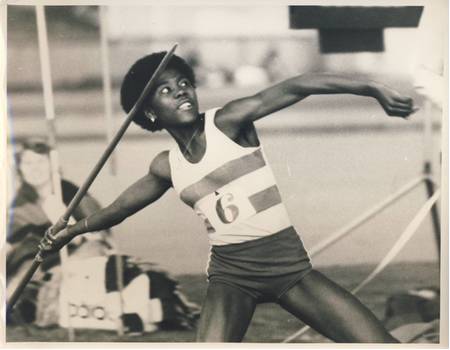


Barbara Richards, her physical education teacher at Ward's Bridge High School, noted her talent for athletics and encouraged her to succeed; Richards threatened to place Sanderson in after-school detention if she did not train, an approach which Sanderson later said helped. She first threw a javelin at age 14, betting with a friend for a bag of chips on who would be able to throw it further.
Athletic Career: Early Years
Sanderson was a member of Wolverhampton & Bilston Athletics Club, competing in the javelin throw and multi-event disciplines. In 1972, aged 16, Sanderson won the Intermediate javelin event at the English Schools' Athletics Championships.
She was selected to compete in the javelin throw at the 1973 European Athletics Junior Championships the following year, where she reached the final but finished 12th with a throw of 39.18 m (128 ft 61⁄2 in) – well behind the winner, Tonya Khristova of Bulgaria, who threw 54.84 m (179 ft 11 in).
Sanderson then decided to focus on the javelin throw rather than the pentathlon, partly because she thought that javelin competitions would provide more opportunities for travel. She made her senior international debut in the javelin throw at the 1974 British Commonwealth Games, finishing fifth.


Later that year, Sanderson finished 13th in the 1974 European Athletics Championships. She broke the British javelin-throw junior record five times, achieving a distance of 55.04 m (180 ft 63⁄4 in) in 1974. Sanderson set the national record in 1976, throwing 56.14 m (184 ft 2 in), and went on to set ten national records and five Commonwealth records.
The 1976 season saw Sanderson's debut at the Olympics. Aged 20, she was the youngest competitor in her event and threw 57.00 m (187 ft 0 in) to finish ninth.[1] In July 1977, at the European Cup semi-finals in Dublin, she threw 67.20 m (220 ft 51⁄2 in) – a national record and the second-longest distance by a woman at the time. At the European Cup finals, Ruth Fuchs of East Germany won the gold and Sanderson took the silver. Later that year, Sanderson was the bronze medalist at the 1977 IAAF World Cup.
Sanderson won her first major gold medal with a throw of 61.34 m (201 ft 23⁄4 in) in the 1978 Commonwealth Games, the first time England had won Commonwealth gold in the women's javelin since 1962. A few weeks later, Sanderson took silver at the 1978 European Athletics Championships behind Fuchs; she was the bronze medalist at the 1979 European Cup again behind Fuchs, both of them losing out to Romanian Éva Ráduly-Zörgő. Selected for the 1980 Summer Olympics, she failed to meet the qualifying standard for the final, reaching only 48.76 m (159 ft 111⁄2 in) with her first throw and having her other two attempts declared no-throws.


After the 1980 Summer Olympic Games, Sanderson asked Wilf Paish of the Carnegie Institute of Physical Education in Leeds to become her coach, and lived with his family once he agreed.[12] A throw of 61.56 m (201 ft 111⁄2 in) was enough for Sanderson to win at the 1981 Pacific Conference Games. At the 1981 European Cup, she was runner-up behind Antoaneta Todorova of Bulgaria who made a world-record throw of 71.88 m (235 ft 93⁄4 in).
She also competed in the pentathlon and heptathlon, setting UK and Commonwealth records for the heptathlon twice in 1981. Later that year, Sanderson had an achilles tendon rupture in her left leg and broke a bone in her throwing arm. Surgery on her Achilles tendon was unsuccessful, and she required another operation; the injuries prevented her from competing for 22 months.
After returning, Sanderson achieved her career-best javelin throw of 73.58 m (241 ft 43⁄4 in) at the Tarmac Games in Edinburgh on 26 June 1983. It was the third-longest throw by a woman at the time, when the record was 74.76 m (245 ft 31⁄4 in) thrown by Tiina Lillak of Finland ten days previously. Sanderson finished fourth at the 1983 World Championships; another British competitor, Fatima Whitbread, who was coming to the fore as her rival, won silver.

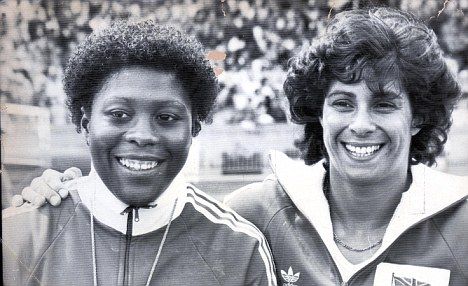


After re-injuring her Achilles tendon at the championship, Sanderson had surgery on both Achilles tendons a few days after the competition ended.
Olympic Gold and Later Career
Sanderson won the gold medal at the 1984 Summer Olympics in the javelin, setting a new Olympic record with her throw of 69.56 m (228 ft 21⁄2 in). Whitbread won the bronze; it was Great Britain's first Olympic win in a throwing event since the modern Olympics began in 1896. Sanderson is the first Black British woman to win an Olympic gold medal.
Sanderson wrote in her 1986 autobiography that following her Olympic victory, she had not intended to compete in the following athletics season, but she did take part in several competitions after being persuaded by her management company IMG to do so.
Although she finished behind Whitbread in five successive meetings, Sanderson did produce the fourth-longest women's javelin throw of the year. She won gold at the 1986 Commonwealth Games in Edinburgh, and Whitbread took the silver medal.


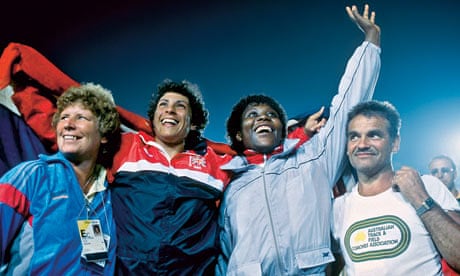
In March 1987, Sanderson announced that she would change her focus from the javelin throw to the heptathlon. Shortly before then, she had moved to London and was looking for a career in television or promotional work. In fact, she only competed in one heptathlon after this, in July. At the Dairy Crest Games in August, Whitbread (who had been undefeated during the season) injured her shoulder; Sanderson won the event.
Sanderson then announced that she would train with Mick Hill in Italy for the world championships. Whitbread won the world championship, and Sanderson finished fourth.
About ten days before participating in the 1988 Summer Olympics as defending champion, Sanderson burst the skin around her ankle and exposed her Achilles tendon. She failed to qualify for the final and left the competition limping, with blood visible on the bandage on her injured ankle. Sanderson left the stadium on crutches before the medal ceremony, where Whitbread received the silver medal behind Petra Felke from East Germany.


Sanderson announced after the 1988 Olympics that she would retire from the javelin throw, but made an unexpected return to competition in 1989 at the McVitie's International Challenge; she finished third. She also finished third at the 1989 European Cup, despite not being in top condition.
At the 1990 Commonwealth Games, a throw of 65.72 m (215 ft 71⁄4 in) was enough for Sanderson to retain her title. She finished 12th at the 1990 European Athletics Championships, but was later moved up to 11th. Aged 35, Sanderson won at the 1991 European Cup over a field which included world-record holder Felke.
Her fifth Olympic Games appearance, at the 1992 Summer Olympics, set a record for Olympic appearances by a British athlete. Sanderson's best throw, 63.58 m (208 ft 7 in), was almost five metres less than the winning throw of 68.34 m (224 ft 21⁄2 in) by Silke Renk and 3.28 metres less than bronze medalist Karen Forkel.


She won gold at the 1992 World Cup with a throw of 61.86 m (202 ft 111⁄4 in), nearly three metres further than any other competitor.
Rivalry with Fatima Whitbread
Alan Hubbard wrote in a 1990 article in The Observer about Sanderson and Whitbread that "their hate-hate relationship has been one of the most enduring in British sport", lasting almost a decade.
The same year, Matthew Engel wrote in The Guardian that "the Sanderson-Whitbread feud is, of course, one of the most splendid in sport", and Tom Lamont, in the same newspaper 29 years later, commented that "Whitbread and Sanderson were always uneasy rivals and the enmity that developed during their overlapping careers became as famous as their achievements, and seems to survive in their retirement”.
Hubbard cited Sanderson's perception that Whitbread received preferential treatment from the British Amateur Athletic Board. The Board's promotions officer, Andy Norman, who had a role in setting British athletes' fees, was a family friend of Whitbread and her mother and coach, Margaret.


Margaret Whitbread was also the national coach for women's javelin in 1985, when her daughter was often participating in international events compared to only one in the season up to June 1985 for Sanderson. In 1987, Sanderson threatened to boycott athletics events, for which she was being paid £1,000 each by British Athletics compared to Whitbread's £10,000. Sanderson agreed to a new deal at the beginning of June that year.
Sanderson also objected to the endorsement that the Whitbreads had given to the Australian athlete Sue Howland, who competed at the 1990 Commonwealth Games after a two-year doping suspension, saying that she felt that they should have supported British athletes instead.

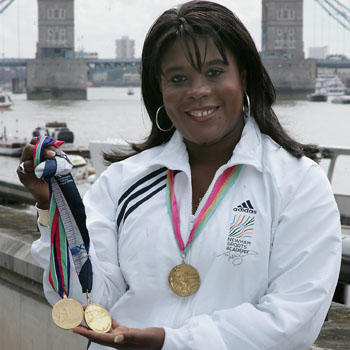

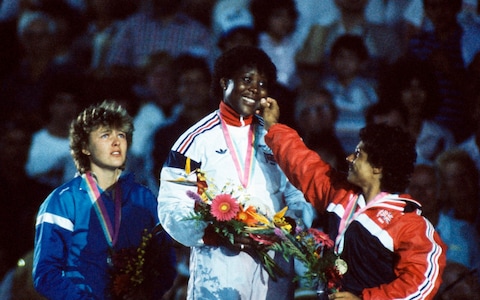
During their respective careers, Sanderson won an Olympic and three Commonwealth golds, and Whitbread gained one world and one European title. In all, Sanderson placed higher in 27 of the 45 times that they faced each other in competition, although Whitbread had the better results of the pair from 1984 to 1987.
In 2019, Sanderson told an interviewer from The Daily Telegraph that although she had initially been on friendly terms with Whitbread, before "the competition got to Whitbread's head" and they fell out, "The rivalry was one of the best things when you look at it now. It drove me to another level. It made me want to beat her every time. It's calmer now. I respect her and I hope she respects me.”