January 17th: Today's Feature - Mural Commemorating 1977 Battle of Lewisham
- Jan 17
- 3 min read
January
Mural Commemorating 1977 Battle of Lewisham
On the 13th August 1977, a disturbing event unfolded in the vibrant streets of south-east London. A group of 500 individuals belonging to the neo-Nazi National Front embarked on a march from New Cross to Catford, fueled by their deep-rooted hatred for the multiculturalism that had flourished in this area. However, their intentions were swiftly met with fierce opposition from a resolute crowd of 4,000 counter-protestors.


United in their determination, these brave individuals effectively barricaded the National Front's path through New Cross, compelling the authorities to redirect their course. The tension escalated further when violent clashes erupted between the police and the unwavering counter-demonstrators in the heart of Lewisham town centre.


London was plunged into darkness as a grim day unfolded, leaving 11 policemen injured and a staggering 214 individuals apprehended. In a historic moment, riot shields were introduced on the British mainland, forever etching their place as a symbol of the turbulent 1980s. Despite the impassioned plea from The All Lewisham Campaign Against Racism and Fascism (ALCARAF) to cancel the National Front's march, their call fell on deaf ears as the Met Police chose to disregard it.
The coverage of the riots was as biased as it was dark, with blame being unfairly placed on the anti-fascists alongside the National Front. However, despite this negative portrayal, the protestors managed to achieve their goal of preventing the racists from reaching their intended destination.


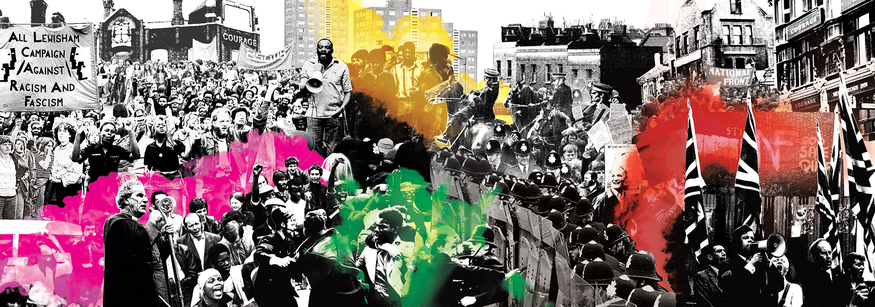
The 'Battle of Lewisham' has now been immortalized through a captivating mural that pays tribute to the brave demonstrators and community leaders who risked their safety to combat hatred. The mural, designed by talented Goldsmiths graduate Ted Low in collaboration with a community advisory group, showcases a bold and vibrant aesthetic. With splashes of bright pink, yellow, green, and red, the artwork draws inspiration from the reggae and anti-fascist punk culture of the 1970s, as well as the smoke bombs that were utilized during the protests.
The original photographs that serve as the basis for this artwork were captured by a group of highly esteemed social documentary photographers during that particular era. Among these talented individuals are Chris Schwarz, Syd Shelton, Paul Trevor, Chris Steele-Perkins, Peter Marlow, and Homer Sykes, all of whom have made significant contributions to the field. Their images provide a powerful and authentic representation of the social and cultural context of the time, making them ideal for this project.


In order to ensure that the mural accurately reflects the sentiments and aspirations of the local community, their input is being sought regarding the provisional design. This inclusive approach allows the residents of New Cross to actively participate in shaping the final outcome of the artwork, fostering a sense of ownership and pride in their shared history. By engaging with the community, the mural will not only serve as a visual representation of the Battle of Lewisham but also as a testament to the unity and resilience of the people who stood against fascism.
The powerful artwork, reminiscent of the iconic Battle of Cable Street mural in the East End, was formally unveiled at Goldsmiths, University of London on Saturday 26 October 2019, offering the community an opportunity to reflect on and commemorate this important moment in history.


Professor Frances Corner, Warden of Goldsmiths, emphasised the significance of their new artwork in preserving the memories of a community while also introducing this important subject to future generations. The mural serves as a powerful reminder of the not-so-distant past, highlighting how bitterness and negativity can take root and spread within our society. However, it also serves as a beacon of hope, reminding us that through unity and collaboration, we have the power to overcome those who seek to divide and destroy.
Dr. John Price, Head of the Department of History at Goldsmiths, praised the vibrant public artwork for commemorating a pivotal moment in the history of anti-fascism and anti-racism in the UK. He remarked on how this artwork will serve as a permanent reminder of the remarkable achievements that can be accomplished when communities unite to resist and combat bigotry in all its forms.

Drawing parallels to the Battle of Cable Street, the Battle of Lewisham holds immense significance for south London, and it is fitting that both events are now honoured with commemorative plaques and prominent public art installations.