February 24th: Today’s Feature - Hew Donald Joseph Locke, OBE, RA, Sculptor and contemporary Visual Artist
- Feb 24
- 5 min read
February
Hew Donald Joseph Locke, OBE, RA, (born 13 October 1959) is a British sculptor and contemporary visual artist based in Brixton, London. In 2000 he won a Paul Hamlyn Award and the EASTinternational Award. He grew up in Guyana, but lived most of his adult life in London.
Background
Born in Edinburgh, Scotland, in 1959, Locke is the eldest son of Guyanese sculptor Donald Locke (1930–2010) and British painter Leila Locke (née Chaplin) (1936–1992). He spent his formative years (1966 to 1980) in Georgetown, Guyana, before returning to the UK to study. He received a B.A. Fine Art degree in 1988 from Falmouth University, and an M.A. in Sculpture from the Royal College of Art, London, in 1994. In 1995 he married curator Indra Khanna.

In 2010 he was shortlisted for the Fourth plinth, Trafalgar Square, London. In 2015 Prince William, Duke of Cambridge dedicated Locke's public sculpture The Jurors, commissioned to commemorate 800 years since the signing of Magna Carta.
Locke has had several solo exhibitions in the UK and USA, and is regularly included in international exhibitions and Biennales. His works have been acquired by collections such as Pérez Art Museum Miami (PAMM), Florida, The Tate gallery, London and The Metropolitan Museum of Art, New York. In 2016, the National Portrait Gallery in London acquired a portrait of Locke by Nicholas Sinclair. In 2022 he became a member of The Royal Academy of Arts.
He was appointed Officer of the Order of the British Empire (OBE) in the 2023 Birthday Honours for services to art.
Work and themes
Prof. Dr. Ingrid von Rosenberg has written: "(Black) Artists who continue to produce work with a critical message, like Yinka Shonibare and Hew Locke, avoid the open confrontation typical of the 1980s and instead use humour and satire, positioning themselves as cultural insiders, rather than excluded outsiders."


He has cited architecture ranging from the Baroque, Rajput, Islamic, and Caribbean vernacular to Victorian funfairs as influences. Locke uses a wide range of media, makes extensive use of found objects, and his recurrent themes include cardboard, royalty, public statues, boats, finance and trade.
Cardboard
Locke said about misreadings of his work in his early career: "I would make a sculpture and people would think it was made for some festival....It was seen as being from a folk tradition, not as being of its own tradition, true to itself – as art basically...I stopped making work in colour for three years, I just dropped it."

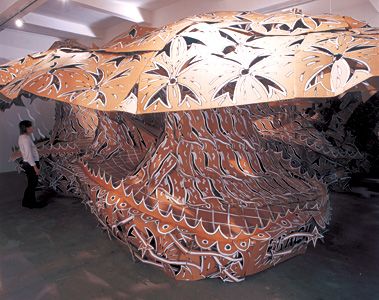


Curator Kris Kuramitsu wrote: "Frustrated by the fact that his biography so heavily over-determines the reading of his work, he created a series of sculptures in which he used cardboard to preemptively package the work for the viewer. This move was revelatory for Locke's practice, as through this material he could metonymically address migration, international economics, globalisation and ideas about personal and cultural protection and projection.”
Royalty
His ongoing series House of Windsor consists of portraits of members of the British royal family.
He has said: "People ask me why I'm working on pictures of the royal family....They expect me to be angry, but I don't see the point. If you're going to fight in Iraq, then you're going to fight for Queen and Country. When you hand in your passport, you see that you are in fact a subject of the Queen. My work is a weird kind of acceptance of that situation.”


"My feelings about the Royal Family are ambivalent. I am simply fascinated by the institution and its relationship to the press and public. My political position is neither republican nor monarchist.”
Statues
In an interview with Simon Grant, Locke said "the legacy of empire is all around us on a daily basis – not just the variety of ethnic backgrounds that we have living in the UK, but the buildings and public statues that you see in cities across the country that came into being out of the economy of empire.”


Locke often works over photographs of specific statues, covering areas with painted or collaged designs. The press release for his work Restoration describes "Hew Locke’s embellishment, directly on to the photographic print, interrupts our expectation that the surface of the photographic image should be left pristine. We can only guess at what lies beneath ...It is perhaps the image of Colston that is most haunting. He is adorned with cowrie shells and other trade beads ... we are made aware of his ... involvement in the uncomfortable truths of corrupt African Kingdoms selling their people ... Locke views this work as an act of 'mindful vandalism', an exploration of these characters who he finds both attractive and repellent.”


Locke said: "When travelling around Britain, the first things I’m looking for are the statues ... I often think 'why have they got a statue to this person and why to that person?' ... On a purely aesthetic level I often find these historical monuments beautiful and have a genuine respect for their skilled academic sculptors. I have a somewhat schizophrenic response. It is not an anti-military critique, but an investigation into the idea of the Hero, and a meditation on our relationship with monumental public sculpture.”
Boats
Ships have been a constant theme in his work throughout his career, ranging from small paintings to installations filling a church nave or an installation across an entire battle ship. A major example of Locke's interest in navigational vessels in visual arts is his 2011 installation For Those in Peril on the Sea, acquired by the Pérez Art Museum Miami.


He has said: "I have a deep personal compulsion to make at least one boat every two years or so. It is part of my personal history, having sailed to and from Guyana to England as a child.”
In his quest to understand the visual language of power, Locke delves into the intricate ways in which different nations construct their identities through visual symbols of authority. He explores how these representations evolve and transform over time, influenced by historical events and societal changes.


Locke's artistic journey encompasses a vast array of subject matters, imagery, and artistic mediums. His artworks are a testament to his ability to weave together diverse sources from various periods and geographical locations, resulting in deeply layered and thought-provoking pieces.


Locke's artistic practice is characterised by his meticulous attention to detail and his ability to create visually captivating artworks that challenge the viewer's perception. Through his exploration of power dynamics and the manipulation of visual symbols, he invites us to question the narratives and ideologies that shape our understanding of authority and identity. Locke's work serves as a powerful reminder of the complex and ever-changing nature of visual representation, urging us to critically examine the symbols and images that surround us in our daily lives.