June 3rd: Today's Feature
- webbworks333
- Jun 2, 2025
- 3 min read
June
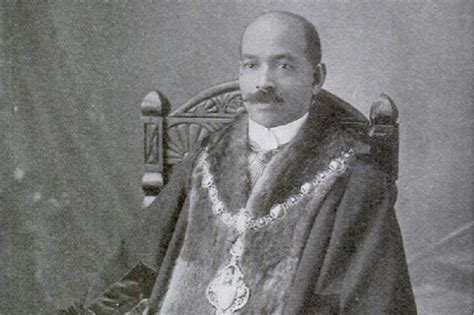
John Richard Archer, born in 1863 and passed away in 1932, was a prominent British politician and activist.
He made history in 1913 by becoming the first black mayor of a London borough, specifically Battersea.
Archer was recognised for his Pan-Africanist beliefs and served as the inaugural president of the African Progress Union.

Life & Career
Archer's life began in Liverpool, Lancashire, where his parents hailed from Barbados and Ireland. As a seaman, he explored various parts of the world, residing in the US and Canada for a time. In his thirties, Archer settled in Battersea, England, alongside his wife Bertha, a black Canadian.
While pursuing his studies in medicine, he sustained himself through a small photography studio. Engaging in local politics, Archer aligned himself with the radical Liberal John Burns and formed connections with London radicals. In 1906, he secured a seat on the Battersea Borough Council as a Progressive (Liberal) representative for Latchmere ward.


Although he championed a minimum wage of 32 shillings per week for council workers, Archer lost his seat in 1909 but was re-elected in 1912. In 1913, he was nominated for the mayoral position, which held more political significance at the time rather than the ceremonial role it later assumed. The campaign was marred by negative and racist elements, including allegations questioning his British nationality. Despite the challenges, Archer emerged victorious with a slim margin of 40 votes to 39 among his fellow councillors, delivering a memorable victory speech:
"My election tonight means a new era. You have made history tonight. For the first time in the history of the English nation a man of colour has been elected as mayor of an English borough.
"That will go forth to the coloured nations of the world and they will look to Battersea and say Battersea has done many things in the past, but the greatest thing it has done has been to show that it has no racial prejudice and that it recognises a man for the work he has done.”


His achievements were documented in the US publication The Crisis in January 1914, which was released by the newly established National Association for the Advancement of Coloured People (NAACP).
During his time in Battersea, Archer shifted towards the left and was re-elected to the council as a Labour representative in 1919. He served as the first president of the African Progress Union in 1918, advocating for progressive African concepts in education. Additionally, he represented Britain at the Pan-African Congress in Paris in 1919 and chaired the London Pan-African Congress two years later.


In 1922, Archer resigned from his council position to work as the Labour Party election agent for Shapurji Saklatvala, a Communist Party member running for parliament in North Battersea. He successfully persuaded the Labour Party to support Saklatvala, who became one of the initial Indian MPs in Britain. Despite the eventual division between the Communist and Labour parties, Archer continued to be involved in politics, serving as an agent for the official Labour candidate in the 1929 general election.
Archer held various roles in organisations such as Battersea Polytechnic, the Nine Elms Swimming Club, the Whitley Council Staff Committee, and the Wandsworth Board of Guardians.
Jane Roberts, the widow of former Liberian President Joseph Jenkins Roberts, had journeyed to England in her later years and encountered the Archer couple. She resided with Archer and his wife until she passed away in 1914 at the age of 95.




Initially, Archer was believed to be the first Black man elected as a mayor in Britain. However, the American Negro Year Book 1914 revealed that in 1904, Mr. Allen Glaser Minns, "a man of colour" from the West Indies, had been elected as the mayor of Thetford, Norfolk. This information was included in the report about Archer's election.
Legacy
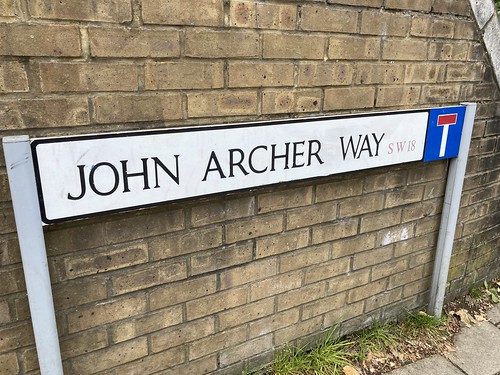
Archer House, part of the Battersea Village estate, was named after Archer during its construction in the 1930s. Wandsworth School was renamed in his honour in 1986 but closed down in 1991. There is a John Archer Way in Wandsworth and a John Archer Hall in Liverpool.

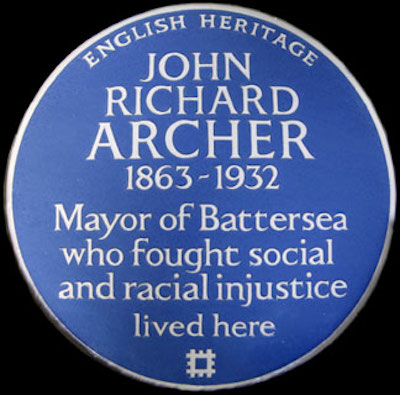

In 2004, John Archer was voted 72nd on the "100 Great Black Britons" list. In 2010, a blue plaque from the Nubian Jak Community Trust was dedicated to commemorate Archer. In April 2013, Royal Mail included Archer in the "Great Britons" commemorative postage stamp issue.
In November 2013, English Heritage honoured Archer with a blue plaque at his former residence on 55 Brynmaer Road, Battersea. Then in March 2018, the Ark Academy Network renamed High View Primary School in Battersea as Ark John Archer Academy.