October 27th: Today's Feature - National Museum Royal Navy
- webbworks333
- Oct 27, 2025
- 5 min read
October
National Museum Royal Navy
During the Second World War the British Empire contributed nearly 3 million personnel for military service. Among these were people from the West Indies, who from the 1940s until the 1970s become known as the ‘Windrush Generation’.
They were air crew for the RAF, fought for the British Army, and served onboard Royal Navy ships. This link between those who sailed onboard HMT Empire Windrush and their role in the Second World War makes it an important topic for the National Museum of the Royal Navy.
Especially now as 2023 marks the 75th anniversary of Windrush, with celebrations ranging from commemorative coins to special events.


Britain had suffered greatly during the course of the Second World War with key cities around Britain, including Portsmouth, having been heavily bombed during the Blitz. In London alone thousands of civilians had been killed and homes destroyed, as well as the many serving personnel impacted across Europe, Asia and beyond.
In 1948 the British Nationality Act was passed. This act created a new citizenship for Great Britain and all its colonies. Offering those in the Commonwealth the opportunity to move to Great Britain and work legally, this act also helped fill the labour gap in the country.
On the 22nd June 1948 His Majesty’s Transport HMT Empire Windrush docked just outside of London. Onboard this ship were commonwealth citizens searching for work, ready to settle in a country that was familiar to most, but a long way from home.

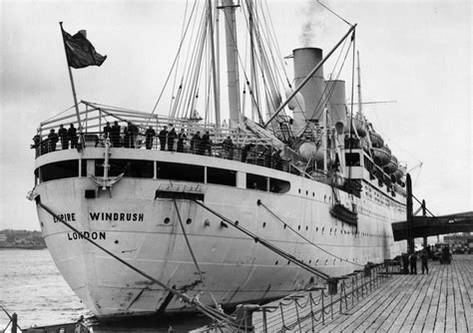

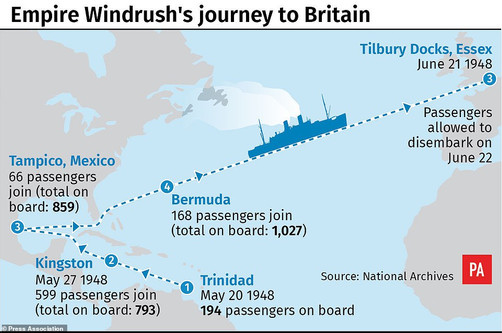
While this was the most well-known voyage of the so-called ‘Windrush Generation’ this group includes multiple trips, on multiple ships, leading all the way to 1971. While the act would not be in effect until the start of 1949, this trip in 1948, alongside some the year before, only became more frequent as time went on.
The idea of working in Britain was an attractive one. For instance, the situation in Jamaica was serious, a hurricane in 1944 had come only months after a drought.
This hurricane destroyed many crops, damaged buildings and killed 30 people in Jamaica alone. Job prospects in Jamaica were poor. Meanwhile Britain in 1948 was still recovering from the devastating damage of the Second World War. The huge loss of life and infrastructure meant that there was a labour shortage the British government was eager to fill.


At the time Great Britain was perceived by some as the mother country, the head of the Commonwealth of which they were a part. The Commonwealth was far more visible in people’s lives. Additionally, many of those onboard were returning from leave from the RAF or veterans who were re-joining.
Not all of those onboard the Empire Windrush in the summer of 1948 were from the Caribbean. Some were British, but more interesting were those who gave ‘Mexico’ as their last country of residence.
These were in fact Polish refugees, who had been taken from their homes by Russia during the Second World War, and sent to labour camps in Siberia. Surviving this horror, they had found themselves in Mexican refugee camps.



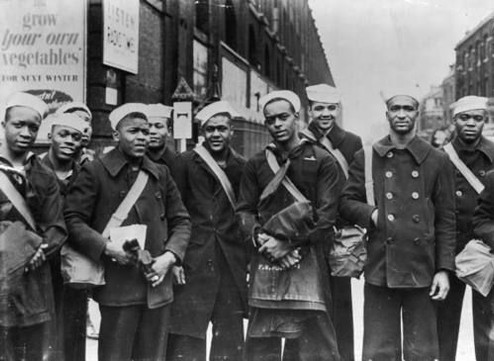
Early Naval History: Black Sailors in the British Navy
During the 1700s and 1800s Britain’s navy was the largest in the world. The Royal Navy’s increasing demand for manpower led it to draw its personnel from across the globe as well as the British Isles. Black men (free and enslaved) from the Americas, the Caribbean, Africa and Britain served on Royal Navy vessels in a number of capacities from ship’s cook to, in one known case, ship’s captain (Captain John Perkins).
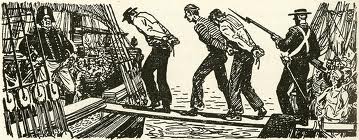
Enslaved labour was sometimes used on naval vessels particularly in North America and the Bahamas. Men running away from slavery sometimes gained their freedom by joining the Royal Navy. Black men with previous merchant sailing experience were often pressed (captured and forced against their will) into the Navy. More still entered the service as volunteers.
The tablet below commemorates the Admiralty's apology for the murder of two quarrymen (Alexander Andrews and Rick Flann) and one blacksmith (William Lano), during an illegal attempt to impress them on the Isle of Portland in Dorset on 2 April 1803. A young lady, Mary Way, was also murdered according to a Coroner's inquest. The illegality of the raid was confirmed in the London and local courts.




Henry George
Born in Jamaica. Served in the Royal Navy for four years. Lost both his feet due to wounds in his legs. A married man when he arrived at Greenwich Hospital on 15 May 1782. Died at Greenwich Hospital on 15 November 1782.
The National Archives (TNA), ADM/65/83 (14, 15)

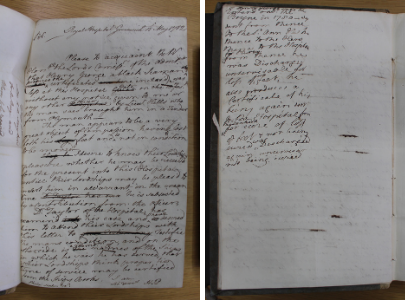
This letter from Philip Stephens, Secretary to Greenwich Hospital, describes how Henry George became a Greenwich Pensioner:
‘Henry George a black Seaman…was left at this Hospital Gate on the 15th… by Lieutenant Hills who the man says brought him in a tender from Plymouth.
The man appears to be a very great object of compassion having lost both his feet and is not in condition to be moved. I desire to know…whether he may be received for the present into this Hospital…In the meantime he is subsisted by a contribution from the officers.
Dr Taylor of the Hospital has examined his case and I have desired him to attend their Lordships with this letter to testify to the man’s condition and on the other side is a memo of names of the ships in which he says he has served’.
John Simmonds
Born in Kingston, Jamaica between 1783 and 1785. Pressed into the Royal Navy in 1803. Served on several ships including HMS Conqueror at the Battle of Trafalgar. Admitted as a patient to Greenwich Hospital in 1824.

The family of John Simmonds
John Simmonds was a Greenwich Pensioner of mixed heritage. He may have been the son of a plantation owner and an enslaved woman. In 1803 he was pressed into service on board HMS Revolutionnaire before transferring to HMS Conqueror. The Conqueror was the ship that took the surrender of the French commander, Admiral Villeneuve, after the Battle of Trafalgar on 21 October 1805. Simmonds went on to gain the rank of Quarter Master while serving on HMS Variable.
Following a bout of yellow fever, Simmonds was admitted to Greenwich Hospital as a Pensioner in 1824. He married a White Londoner, Ann Fouch, in Clerkenwell before moving to Mansfield where they worked as hawkers.
In 1846 John Simmonds received the Trafalgar Medal. He died in Mansfield in 1858.
Remembering the Navy's black recruits old and new

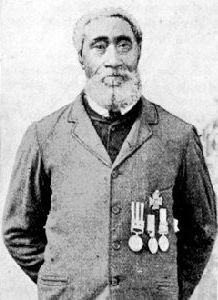



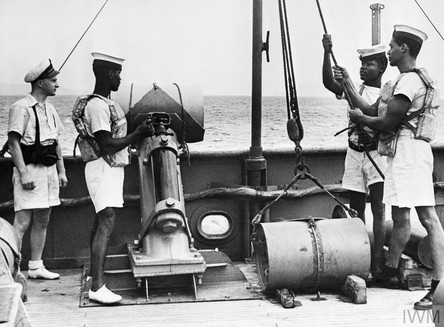
The anniversary of Windrush is celebrated every year on the 22nd June, and 2023 marks the 75th anniversary of this significant trip. For those who may have made that difficult journey, have family members who did, or are just interested, the National Museum of the Royal Navy has collated photographs and items related to the heritage of some of the Windrush countries. While we hope this collection grows, these objects can be viewed on our Collections Portal.
Refs: