November 10th: Today's Feature - Winifred Atwell
- Nov 10, 2025
- 5 min read
November
Una Winifred Atwell: Part 1 (27 February or 27 April 1910 or 1914 – 28 February 1983) was a Trinidadian pianist who enjoyed great popularity in Britain and Australia from the 1950s with a series of boogie-woogie and ragtime hits, selling over 20 million records. She was the first black artist to have a number-one hit in the UK Singles Chart and as of 2023, remains the only female instrumentalist to do so.
Childhood
Atwell was born in Tunapuna in Trinidad and Tobago. She and her parents lived in Jubilee Street. Her family owned a pharmacy and she trained as a pharmacist herself and was expected to join the family business. She played the piano from a young age and achieved considerable popularity locally. She played for American servicemen at the Air Force base (which is now the main airport).


It was while playing at the Servicemen's Club at Piarco that someone bet her that she could not play something in the boogie-woogie style that was popular back home in the United States. She went away and wrote "Piarco Boogie", which was later renamed "Five Finger Boogie”.
Leaving Trinidad
Atwell left Trinidad in the early 1940s and travelled to the United States to study with Alexander Borovsky. A newspaper clipping reveals that she played in a concert at The Town Hall in New York on 10 May 1945, as part of a presentation by the Altruss Opera Company starring Paul A. Smith, a well-known tenor.
On 6 October 1945, it was announced that "the noted West Indian pianist" had left for England where she would broadcast for the BBC on Tuesdays and Thursdays. In London, she gained a place at the Royal Academy of Music where she completed her musical studies.


She became the first female pianist to be awarded the academy's highest grading for musicianship. To support her studies, she played rags at London clubs and theatres. From those modest beginnings in variety she went on to top the bill at the London Palladium. She said later, "I starved in a garret to get onto concert stages.”
Life in the UK
On 21 October 1946, Atwell appeared on BBC TV program "Stars In Your Eyes", which was quickly followed by several radio appearances on the Light Programme. In January 1947, she headed the bill of "Come to the Show" at the Empire Theatre, Belfast, where she was billed as "radio's most versatile pianist". Frequent radio appearances continued, including the well-known "Variety Bandbox" show. She appeared on the variety stages too, sometimes with another pianist called Donald Thorne.
Atwell attracted attention with an unscheduled appearance at the Casino Theatre, where she substituted for an ill star. She caught the eye of entrepreneur Bernard Delfont, who put her on a long-term contract in 1948. Atwell was championed by popular disc jockey Jack Jackson, who introduced her to Decca Records promotions manager Hugh Mendl.


Mendl launched his career as a staff producer at Decca by producing Atwell's recordings. She released a number of discs for Decca in 1951 that were well received. "Jezebel" sold well, but it was another disc that catapulted her to huge popularity in the UK.
A complex arrangement called "Cross Hands Boogie" was released to show her virtuoso rhythmic technique, but it was the B-side, a 1900s tune written by George Botsford called "Black and White Rag", that was to become a radio standard.
"Black And White Rag" started a craze for her honky-tonk style of playing. The rag was originally performed on a concert grand for the occasion, but Atwell felt it did not sound right, and so got her husband to buy a honky tonk piano for 30 shillings, which was used for the released version of the song.
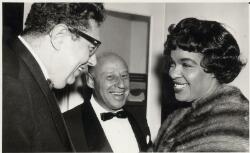


Atwell's husband, former stage comedian Lew Levisohn, was vital in shaping her career as a variety star. The two had met in 1946, and married soon after. They were inseparable up to Levisohn's death in Hong Kong in December 1977. They had no children. He had cannily made the choice, for stage purposes, of her playing first a concert grand, then a beaten-up old upright piano. The latter was purchased from a Battersea junk shop for 50 shillings.


It became famous as "my other piano", and would later feature all over the world, from Las Vegas to the Sydney Opera House, travelling over half a million miles by air throughout Atwell's concert career. While contributing to a posthumous BBC Radio appreciation of Atwell's career, Richard Stilgoe revealed that he had become the owner of the famous "other piano”.
When Atwell first came to Britain, she initially earned only a few pounds a week. By the mid-1950s, that had shot up to over $10,000. By 1952, her popularity had spread internationally. Her hands were insured with Lloyd's of London for £40,000, the policy stipulating that she was never to wash dishes. She signed a record contract with Decca, and her sales were soon 30,000 discs a week. She was by far the biggest-selling pianist of her time. Her 1954 hit, "Let's Have Another Party", was the first piano instrumental to reach number one in the UK Singles Chart.


She is the only holder of two gold and two silver discs for piano music in Britain, and was the first black artist in the UK to sell a million records. Millions of copies of her sheet music were sold, and she went on to record her best-known hits, including "Let's Have a Party", "Flirtation Waltz", "The Poor People of Paris" (which reached number one in the UK Singles Chart in 1956), "Britannia Rag" and "Jubilee Rag".
Her signature "Black and White Rag" became famous again in the 1970s as the theme of the BBC snooker programme Pot Black, which also enjoyed great popularity in Australia when screened on the ABC network. It was during that period that she discovered Matt Monro and persuaded Decca to sign him.

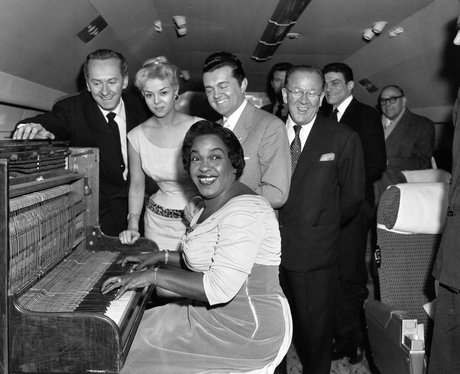


Atwell's peak was in the second half of the 1950s, during which her concerts drew standing-room-only crowds in Europe and Australasia. She played three Royal Variety Performances, appeared in every capital city in Europe, and played for over twenty million people. At a private party for Queen Elizabeth II, she was called back for an encore by the monarch herself, who requested "Roll Out the Barrel". She became a firm television favourite and had her own series in Britain.
The first of them was Bernard Delfont Presents The Winifred Atwell Show. It ran for ten episodes on the new ITV network from 21 April to 23 June 1956, and the BBC picked up the series the following year. On a third triumphal tour of Australia, she recorded her own Australian television series, screened in 1960–1961.


During her career she earned her a fortune, and would have extended to the US but for problem of racial segregation in the United States. Her breakthrough appearance was to have been on The Ed Sullivan Show in 1956, but on arrival in America she was confronted with problems of selling the show in the south with a British-sounding black woman. Her appearance was never recorded. She did, however, have a guest appearance on the Arthur Godfrey show two years later.