November 13th: Today's Feature - Una Marson: Part 1
- webbworks333
- Nov 13
- 5 min read
November
Una Maud Victoria Marson: Part 1
(6 February 1905 – 6 May 1965) was a Jamaican feminist, activist and writer, producing poems, plays and radio programmes.
She travelled to London in 1932 and became the first black woman to be employed by the BBC during World War II. In 1942, she became producer of the programme Calling the West Indies, turning it into Caribbean Voices, which became an important forum for Caribbean literary work.
Her biographer Delia Jarrett-Macauley described her (in The Life of Una Marson, 1905–1965) as the first "Black British feminist to speak out against racism and sexism in Britain”. British civil rights leader Billy Strachan credited Una Marson with educating him on political and racial issues.


Early years (1905–1932)
Una Marson was born on 6 February 1905, at Sharon Mission House, Sharon village, near Santa Cruz, Jamaica, in the parish of St Elizabeth, as the youngest of six children of Rev. Solomon Isaac Marson (1858–1916), a Baptist parson, and his wife Ada Wilhelmina Mullins (1863–1922). She had a middle-class upbringing and was very close to her father, who influenced some of her fatherlike characters in her later works. As a child before going to school, Marson was an avid reader of available literature, which at the time was mostly English classical literature.
At the age of 10, Marson was enrolled in Hampton High, a girl's boarding school in Jamaica of which her father was on the board of trustees. However, that same year, Rev. Isaac died, leaving the family with financial problems, so they moved to Kingston.
She finished school at Hampton High, but did not go on to a college education. After leaving Hampton, she found work in Kingston as a volunteer social worker and used the secretarial skills, such as stenography, she had learned in school, her first job being with the Salvation Army.

In 1926, Marson was appointed assistant editor of the Jamaican political journal Jamaica Critic. Her years there taught her journalism skills as well as influencing her political and social opinions and inspired her to create her own publication. In fact, in 1928, she became Jamaica's first female editor and publisher of her own magazine, The Cosmopolitan.
The Cosmopolitan featured articles on feminist topics, local social issues and workers' rights and was aimed at a young, middle-class Jamaican audience. Marson's articles encouraged women to join the work force and to become politically active. The magazine also featured Jamaican poetry and literature from Marson's fellow members of the Jamaican Poetry League, started
by J. E. Clare McFarlane.
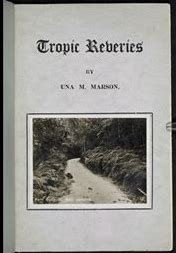
In 1930, Marson published her first collection of poems, entitled Tropic Reveries, that dealt with love and nature with elements of feminism. It won the Musgrave Medal from the Institute of Jamaica. Her poems about love are somewhat misunderstood by friends and critics, as there is no evidence of a romantic relationship in Marson's life, although love continued to be a common topic in her work.
In 1931, due to financial difficulties, The Cosmopolitan ceased publication, which led her to begin publishing more poetry and plays. In 1931, she published another collection of poetry, entitled Heights and Depths, which also dealt with love and social issues.
Also in 1931, she wrote her first play, At What a Price, about a Jamaican girl who moves from the country into the city of Kingston to work as a stenographer and falls in love with her white male boss. The play opened in Jamaica and later London to critical acclaim. In 1932, she decided to go to London to find a broader audience for her work and to experience life outside of Jamaica.



London years (1932–36)
When she first arrived in the UK in 1932, Marson found the colour bar restricted her ability to find work, and she campaigned against it.[8] She stayed in Peckham, south-east London, at the home of Harold Moody, who the year before had founded civil-rights organisation The League of Coloured Peoples.
The League sponsored a production of Marson's play At What a Price in London in the winter of 1932–33.First staged in Kingston, Jamaica, in 1932, this four-act drama explores the experiences of Ruth Maitland, a young woman who leaves behind her family home in the countryside and moves to Kingston to become a stenographer in the office of a white English businessman named Gerald Fitzroy.
He pursues her relentlessly and Ruth becomes pregnant. She returns to the family home, where a long-time admirer proposes marriage. The play explores women’s desires – for love and for a career, as well as interracial relations, sexual harassment in the workplace and women's friendship. It opened at the YWCA Central Club Hall in London on 23 November 1933. It ran for a further four nights in January 1934 at the Scala Theatre on Charlotte Street and Tottenham Court Road.


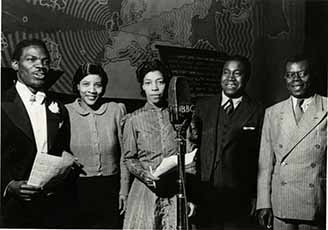
Critics noted the diverse origins and accents of the Black cast who played all twenty roles (including the two white roles), which included activists and artists from Bermuda, British Guiana, England, Gold Coast, India, Italy Jamaica and St. Lucia.
From 1932 to 1945, Marson moved back and forth between London and Jamaica. She continued to contribute to politics, but now instead of focusing on writing for magazines, she wrote for newspapers and her own literary works in order to get her political ideas across. In these years, Marson kept writing to advocate feminism, but one of her new emphases was on the race issue in England.
The racism and sexism she found in the UK "transformed both her life and her poetry": the voice in her poetry became more focused on the identity of black women in England. In this period, Marson not only continued to write about women's roles in society, but also put into the mix the issues faced by black people who lived in England.



In July 1933, she wrote a poem called "Nigger" that would appear in the League of Coloured Peoples' journal, The Keys, on which she worked in an editorial capacity and became Editor for in 1935.
Outside of her writing at that time, Marson was in the London branch of the International Alliance of Women, a global feminist organization. By 1935, she was involved with the International Alliance of Women based in Istanbul.
Jamaica (1936–38)
Marson returned to Jamaica in 1936, where one of her goals was to promote national literature. One step she took in achieving this goal was to help create the Kingston Readers and Writers Club, as well as the Kingston Drama Club. She also founded the Jamaica Save the Children Fund, an organization that raised funds to give the poorer children money to get a basic education.


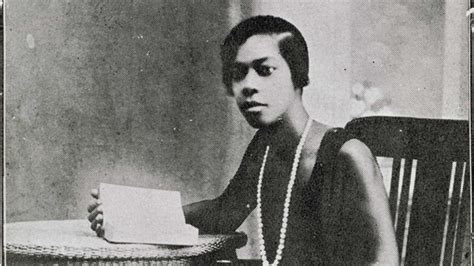
In promoting Jamaican literature, Marson published Moth and the Star in 1937. Many poems in that volume demonstrate how despite the media's portrayal that black women have inferior beauty when compared to the whites, black women should still be confident in their own physical beauty. This theme is seen in "Cinema Eyes", "Little Brown Girl", "Black is Fancy" and "Kinky Hair Blues".
However, Marson herself was affected by the stereotype of superior white beauty; Marson herself, her biographer tells us, within months of her arrival in Britain "stopped straightening her hair and went natural”.
Going along with her feminist principles, Marson worked with Louise Bennett to create another play called London Calling, which was about a woman who moved to London to further her education. However, the woman later became homesick and returned to Jamaica.
Louise Bennett


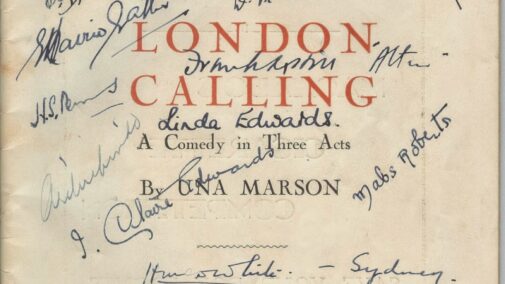
This play shows how the main character is a "strong heroine" for being able to "force herself to return to London" in order to finish her education there. Also in the feminist vein, Marson wrote Public Opinion, contributing to the feminist column.