August 13th: Today's Feature-Earl Cameron
- Aug 12, 2025
- 6 min read
August
Earlston Jewitt Cameron, CBE, (8 August 1917 – 3 July 2020), known as Earl Cameron, was a Bermudian actor who lived and worked in the United Kingdom. After appearing on London's West End stage, he became one of the first black stars in the British film industry.
With his appearance in 1951's Pool of London, Cameron became one of the first black actors to take up a starring role in a British film after Paul Robeson, Nina Mae McKinney and Elisabeth Welch in the 1930s.
According to Screenonline, "Earl Cameron brought a breath of fresh air to the British film industry's stuffy depictions of race relations. Often cast as a sensitive outsider, Cameron gave his characters a grace and moral authority that often surpassed the films' compromised liberal agendas."

He starred alongside Sean Connery in Thunderball (1965). He made appearances in many 1960s British science fiction programmes, including Doctor Who, where he was reportedly one of the first black actors to play an astronaut on television, The Prisoner, and The Andromeda Breakthrough. His film appearances continued until 2013, when he was 96.
Early Career
Cameron was born in Pembroke, Bermuda, and grew up on Princess Street, Hamilton. His father was a stonemason who died in 1922, after which Cameron's mother took on various jobs to support the family. As a young man, Cameron joined the British Merchant Navy: "I was working on a ship, going from Bermuda to New York and back. I always had a great desire to travel as a kid, and so I transferred to another ship called the Eastern Prince sailing to South America. On our second trip, the war started. ...the British Admiralty sent for the ship, and that brought me to London."He went AWOL, claiming: "I arrived in London on 29 October 1939. I got involved with a young lady and you know the rest. The ship left without me, and the girl walked out too."
Cameron faced difficulties as a black person trying to find employment; he was reluctantly taken on as a dishwasher in a hotel and had to accept whatever casual work came his way. In 1941, his friend Harry Crossman gave Cameron a ticket to see a revival of Chu Chin Chow at the Palace Theatre. Crossman and five other black actors had bit parts in the West End production. Cameron, who was working at the kitchen of the Strand Corner House at the time, was fed up with menial jobs and asked Crossman if he could get him on the show. He told Cameron that all the parts had been cast, but two or three weeks later, when one of the actors did not show up, Crossman arranged a meeting with the director Robert Atkins, who cast Cameron on the spot.

According to Cameron, he had an easier time than other black actors because his Bermudian accent sounded American to British ears (Bermuda, nearest to North Carolina, was settled as an extension of Virginia and retained strong links to Virginia and the Carolinas for the first two centuries of settlement, though it had remained British when they and ten other continental colonies had seceded to form the USA). The following year, he landed a speaking role as Joseph, the chauffeur in the American play The Petrified Forest by Robert E. Sherwood. He encountered fellow Bermudian Ernest Trimingham still working in the West End.
Film Career
Cameron's breakthrough acting role was in Pool of London, a 1951 film directed by Basil Dearden, set in post-war London involving racial prejudice, romance — Cameron's character is a merchant sailor who falls in love with a young white woman, played by Susan Shaw — and a diamond robbery. He won much critical acclaim for his part in the film, which is considered "the first major role for a black actor in a British mainstream film".
Cameron's next major film role was in the 1955 film Simba. In this drama about the Mau Mau uprising in Kenya, Cameron played the role of Peter Karanja, a doctor trying to reconcile his admiration for Western civilisation with his Kikuyu heritage. That same year Cameron played the Mau Mau general Jeroge in Safari.

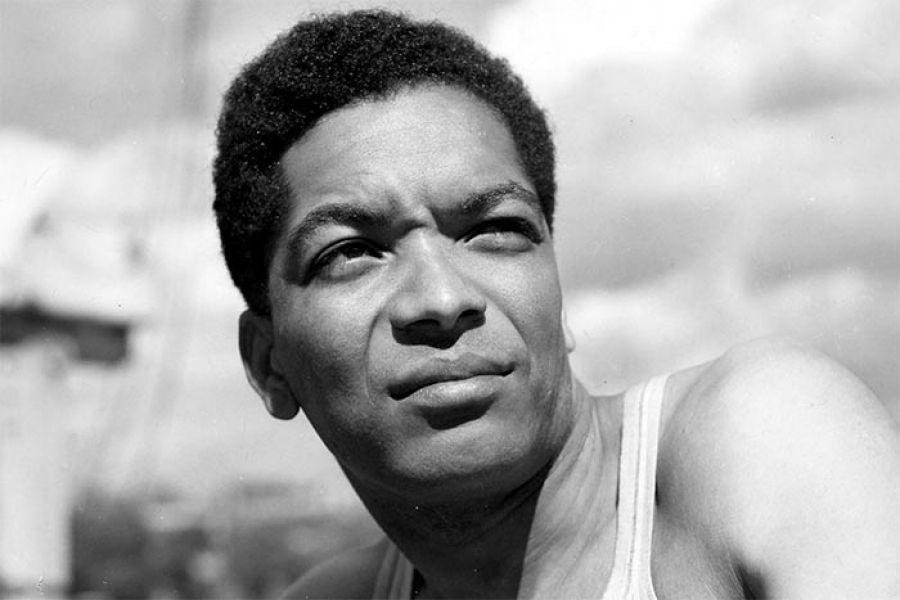
He told The Guardian in a 2017 interview: "I never saw myself as a pioneer. It was only later, looking back, that it occurred to me that I was.” He also found work hard to come by: "Unless it was specified that this was a part for a black actor, they would never consider a black actor for the part. And they would never consider changing a white part to a black part. So that was my problem. I got mostly small parts, and that was extremely frustrating – not just for me but for other black actors. We had a very hard time getting worthwhile roles.”
Television Career
Cameron had roles in a wide range of TV shows, but one of his earliest major roles was a starring part in the BBC 1960 TV drama The Dark Man, in which he played a West Indian cab driver in the UK. The show examined the reactions and prejudices he faced in his work. In 1956 he had a smaller part in another BBC drama exploring racism in the workplace, A Man From The Sun, in which he appeared as community leader Joseph Brent.
Cameron appeared in a range of popular television shows including series Danger Man (Secret Agent in the US) alongside series star Patrick McGoohan. Cameron worked with McGoohan again when he appeared in the TV series The Prisoner as the Haitian supervisor in the episode "The Schizoid Man" (1967)




Radio work
In 2017, a month after his 100th birthday, Cameron was cast in a BBC Radio 4 adaptation of Neil Gaiman's novel Anansi Boys, starring Lenny Henry.
Personal life
From 1963, Cameron was a practitioner of the Baháʼí Faith, joining the religion at the time of the first Baháʼí World Congress, held at London's Royal Albert Hall.
The Baháʼí community held a reception in London in 2007 to honour his 90th birthday. He lived in Kenilworth, Warwickshire, England.[49] He was survived by his second wife, Barbara Bower. His first wife, Audrey Godowski, whom he had married in 1959, died in 1994. He had six children, five by his first marriage.

Honours
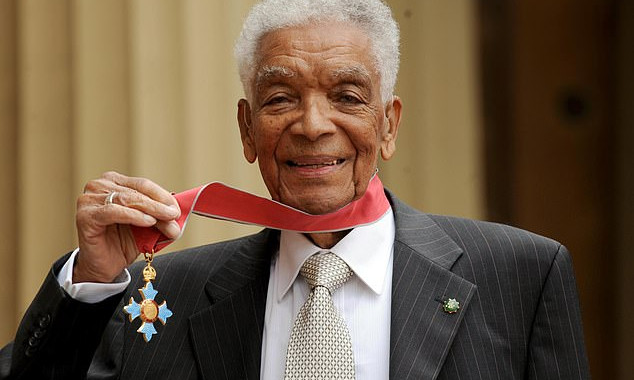
Cameron was appointed Commander of the Order of the British Empire (CBE) in the 2009 New Year Honours.
The Earl Cameron Theatre in Hamilton, Bermuda, was named in his honour at a ceremony he attended there in December 2012.
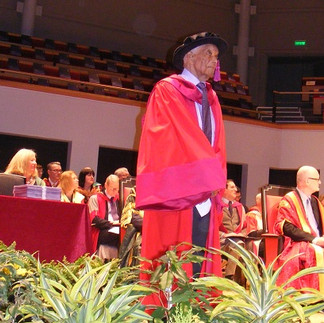
The University of Warwick awarded Cameron an honorary doctorate in January 2013.
In 2015, the British Film Institute (BFI) featured a special presentation and screening to honour Cameron's work.
In September 2016, he became the first inductee into the Screen Nation "Hall of Frame" at the BFI Southbank, where he was interviewed by Samira Ahmed.
In 2017, Cameron's 100th birthday was marked in Bermuda at an event he attended held at the theatre now named in honour of him.
In 2019, the Earl Cameron Award – for "a Bermudian professional who has demonstrated exceptional passion and talent in the field of theatre, cinematography, film or video production" – was established in his honour by the Bermuda Arts Council.




Death and legacy
Cameron died at his home in Kenilworth, Warwickshire, England, on 3 July 2020 at the age of 102, surrounded by his wife and family.
His children said in a statement: "Our family have been overwhelmed by the outpourings of love and respect we have received at the news of our father's passing … As an artist and as an actor he refused to take roles that demeaned or stereotyped the character of people of colour. He was truly a man who stood by his moral principles and was inspirational.”
Bermudian Premier Edward David Burt paid tribute to Cameron, describing him as an "iconic actor" and "a proud son of Bermuda whose constant, dignified presence added to stage and screen over decades. All Bermuda joins with me in celebrating his long and remarkable life.” In the following days Cameron's films were shown on CITV government television.

In the UK, on Twitter, David Harewood described Cameron as a "total legend" and Paterson Joseph wrote: "His generation's pioneering shoulders are what my generation of actors stand on. No shoulders were broader than this gentleman with the voice of god and the heart of a kindly prince."Historian David Olusoga wrote: "A remarkable and wonderful man. Not just a brilliant actor but a link to a deeper history."
In 2021, Burt Caesar programmed a season of films and talks at the BFI commemorating the life and career of Earl Cameron.